
There’s a moment most employers only encounter once. A termination decision has been made. It’s been building for months. The leadership team is aligned. And then someone asks for the documentation — the written record of the performance conversations, the warnings, the opportunities offered — and the room goes quiet.
Not because nothing happened. A lot happened. There were conversations. There were expectations restated in hallways and restated again in meetings. There was a probationary review that kept getting pushed. There was a difficult feedback session that both people remember differently. It all happened. It just wasn’t written down.
That gap, between what happened and what can actually be demonstrated, is where employment decisions stop being defensible.
35%
of employment-related claims in Canada involve employers with fewer than 50 employees
3 to 6 months
typical notice or pay in lieu triggered when progressive discipline records are absent or incomplete
1 conversation
is all it takes to start building a defensible record — if it gets documented
What HR documentation actually is
Most employers think documentation means paperwork. Templates. Forms. Something the HR department handles for the serious situations. That’s not what we’re talking about.
Real HR documentation is a record of the employment relationship as it actually unfolded. What was expected. What was communicated when expectations weren’t being met. What support was offered before consequences followed. It captures the relationship at the time it was happening, not assembled after the fact when things have already gone wrong.
That timing distinction matters more than most leaders realise. A brief written note made the day of a performance conversation carries real weight. A summary reconstructed six months later, when a termination is being planned and memories have diverged, carries almost none. Courts and adjudicators aren’t looking for perfect processes. They’re looking for evidence that the employer acted fairly and in good faith.
The progressive discipline piece
Progressive discipline sounds formal. It isn’t, necessarily. The concept is straightforward: when an employee’s performance or conduct falls short, they deserve to know specifically what the problem is, understand clearly what’s expected, and have a genuine opportunity to course-correct before their employment is seriously at risk.
Documentation is how you show that happened. Without it, two things go wrong at the same time. The employer can’t demonstrate they acted fairly. And the employee, in retrospect, can credibly claim they didn’t understand things were serious. Both of those create problems that are legal, financial, and relational.
What makes the progressive discipline model work isn’t the discipline. It’s the progressive part. It requires that conversations happen early, that expectations are clear, that follow-through is consistent, and that all of it gets recorded in a way that reflects reality. Employers who do this well find that fewer situations escalate to termination in the first place.
The managers who handle this well aren’t paranoid. They’re prepared.
What this looks like in growing organisations
Growing companies tend to manage performance informally. That’s not a character flaw. It’s a natural consequence of how small and mid-size workplaces operate. Leaders wear many hats. Relationships are close. The culture is one of getting things done and moving forward.
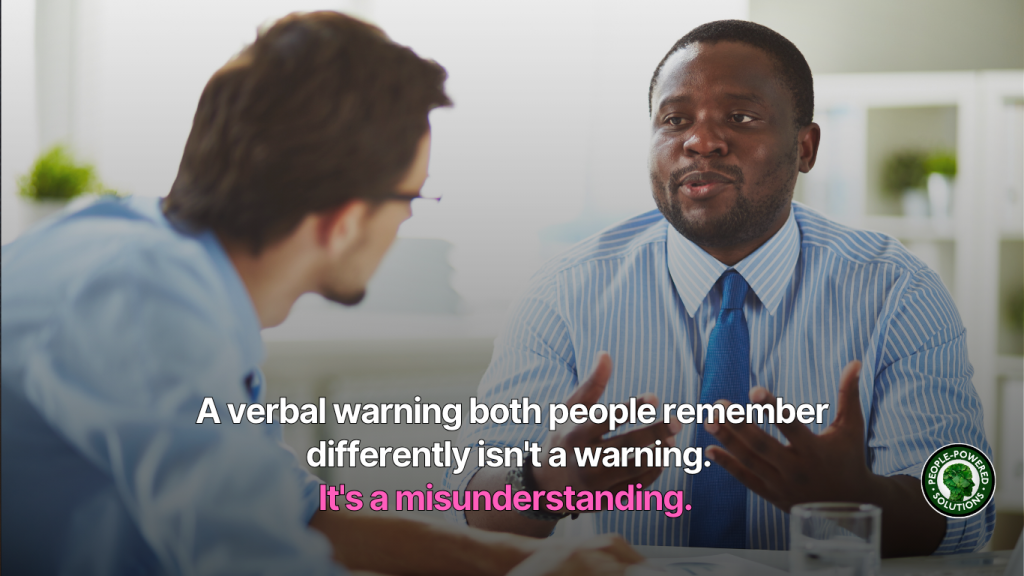
The problem is that informal conversations don’t create records. A verbal conversation that both parties remember differently isn’t a warning. It’s a misunderstanding waiting to surface at the worst possible moment.
What good practice looks like is simpler than most people expect. When a performance issue is identified, it gets documented at the time — not as a formal HR action, but as a brief written note. What was observed. What was discussed. What was agreed to next. Where appropriate, that note is shared with the employee so there’s no ambiguity about what happened in that room. When the follow-up conversation happens, that gets documented too. Over time, those notes become a record of a relationship where both sides were informed and engaged.
This doesn’t require a complex system. It requires a habit, and someone who knows what that habit should look like.
The side of this that rarely gets said
Here’s where this conversation usually stops short. Documentation gets framed entirely as risk management. A way to protect the organisation. That framing is true, but it’s incomplete.
When an employee receives honest, specific feedback at the time something goes wrong, they have a real chance to respond to it. They know what’s expected. They understand what’s at stake. They have an opportunity most employees want: to know where they stand and what they can do about it. Documentation, done well, is evidence that an organization took that responsibility seriously.
The companies that do this consistently aren’t building cases against their people. They’re building a culture where performance conversations happen early, where expectations are clear, and where nobody arrives at a termination meeting wondering whether they ever got a fair chance. That’s a different kind of workplace. It’s also a significantly less expensive one.
What to build before you need it
The right time to create a documentation process is not when a performance situation is already in progress. It’s before. A clear template for performance conversations. A consistent expectation that leaders record the outcomes of those conversations in a shared and secure location. A probationary review process that actually runs on schedule. These three things close most of the gaps that make difficult employment decisions more difficult and more costly than they need to be.
If your organization doesn’t have these in place, the next performance challenge you face will cost more time, more money, and more goodwill than it should. Building the infrastructure before the pressure hits is one of the most practical things a growing organization can do.

