
Every board has one. The member who nods through the treasurer’s report, seconds every motion, and privately wonders what, exactly, they signed up for. If that’s you, you’re in good company. Canada has roughly 170,000 nonprofit organizations, and nearly all of them are governed by volunteers who learned the job by doing it. This guide lays out nonprofit board roles and responsibilities in Canada in plain language: what each officer actually does, what every director owes the organization, and where the board’s work ends and the staff’s begins.
What are the roles and responsibilities of a nonprofit board in Canada?
A nonprofit board in Canada governs the organization. It sets strategic direction, safeguards finances and legal compliance, hires and supervises the senior staff person, and answers to members, funders, and regulators. Every individual director also carries legal duties of care, diligence, and loyalty, whether they hold an officer title or not.
Those duties come from legislation, not from your by-laws. Federally incorporated nonprofits fall under the Canada Not-for-profit Corporations Act. In Ontario, it’s the Not-for-Profit Corporations Act, and other provinces have their own versions. The language differs, but the expectation is the same everywhere: act honestly, act in the organization’s best interest, and bring the attention a reasonably careful person would bring to the job. You don’t need to be a lawyer or an accountant to sit on a board. You do need to show up prepared, ask questions until you understand what you’re voting on, and put the organization’s interest ahead of your own every time they conflict.
That’s the collective job. Within it, the officer roles divide the work.
The chair runs the room and owns the relationship
The chair’s most visible job is running meetings, but that’s the smaller half of the role. The larger half happens between meetings: building the agenda with the senior staff person, making sure directors have what they need before they arrive, and acting as the board’s single point of contact with the executive director so that one person, not twelve, is managing that relationship.
A good chair keeps discussion moving without cutting it off, draws out quiet members, and knows when to call the question. A great chair also protects the line between governance and operations, which we’ll get to shortly, because chairs are usually the first ones tempted to cross it.
The treasurer translates, not just tallies
The treasurer doesn’t do the bookkeeping. In most organizations with staff, they shouldn’t. The treasurer’s real job is translation: taking the financial statements and making them mean something to directors who don’t read balance sheets for a living. Can we afford this program? Are we drifting toward trouble? Is our reserve where our policy says it should be?
The treasurer also chairs the finance committee where one exists, walks the board through the budget, and makes sure the annual filing and audit or review requirements actually get met. If your treasurer’s report is a page of numbers read aloud with no interpretation, the role is being filled but not performed.
The secretary protects the record
Minutes sound like housekeeping until a funder, an auditor, or a lawyer asks what the board decided and when. The secretary makes sure meetings are properly called, quorum is confirmed, decisions are recorded accurately, and the minute book, by-laws, and policies are kept current and findable. When a dispute surfaces two years after a decision, the minutes are often the only evidence of what the board actually approved. Thin records are a real liability, not a paperwork quibble.
Directors at large are not spectators
Directors without a title sometimes assume the officers carry the load and their job is to attend. Legally, that’s wrong. Every director carries the same duties and the same exposure. A director who missed the meeting where a bad decision passed, or who sat silently through it, is not automatically off the hook.
In practice, directors at large are the board’s working capacity. They sit on committees, bring their professional judgment to decisions, champion the organization in the community, and ask the questions officers are too close to see. The strongest boards we work with treat every seat as a working seat.
Where the board’s work ends and the staff’s begins
The cleanest way to hold the line: the board decides what and why, staff decides how. The board approves the budget; staff spends within it. The board sets the strategic direction; staff builds the work plan. The board hires, evaluates, and if necessary replaces one employee, the most senior one, and that person manages everyone else.
Small nonprofits blur this constantly, and sometimes they must. When there’s no staff, board members wear operational hats. That can work, as long as everyone knows which hat is on. The trouble starts when a director gives instructions to staff directly, or when the board spends its meeting choosing paint colours while the strategic plan gathers dust.
What happens when nobody knows whose job it is
We spent part of this spring rewriting by-laws and fundraising policies with a community nonprofit, and the pattern we found there shows up almost everywhere. The board wasn’t careless. It was full of committed people doing real work. But roles had been passed down by word of mouth, the by-laws hadn’t been touched in years, and nobody could say for certain who was allowed to sign what. Decisions slowed. Volunteers duplicated effort. One dispute over fundraising authority took three meetings to untangle because no document settled it.
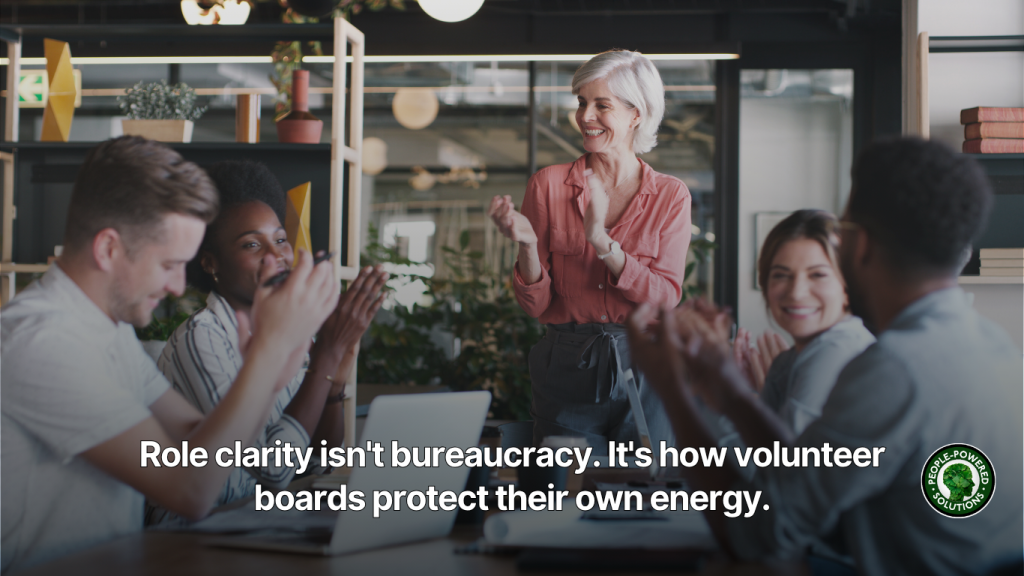
Clear roles fixed most of that before any new policy did. Once the board could point to who owned the record, who owned the money conversation, and who spoke for the board, the meetings got shorter and the arguments got rarer. Role clarity isn’t bureaucracy. It’s how volunteer boards protect their own energy.
Start with your own board
Pull out your by-laws and read the officer descriptions against what people actually do. If the two don’t match, that gap is your first governance project, and it’s a manageable one. We’re building our Governance Essentials course around exactly this work, shaped by what we see inside real boardrooms, and it starts with roles because everything else in governance leans on them.
If your board wants help sooner, talk to us. We work with boards across Northern Ontario and beyond on governance, leadership development, and the unglamorous documents that make both stick.

