
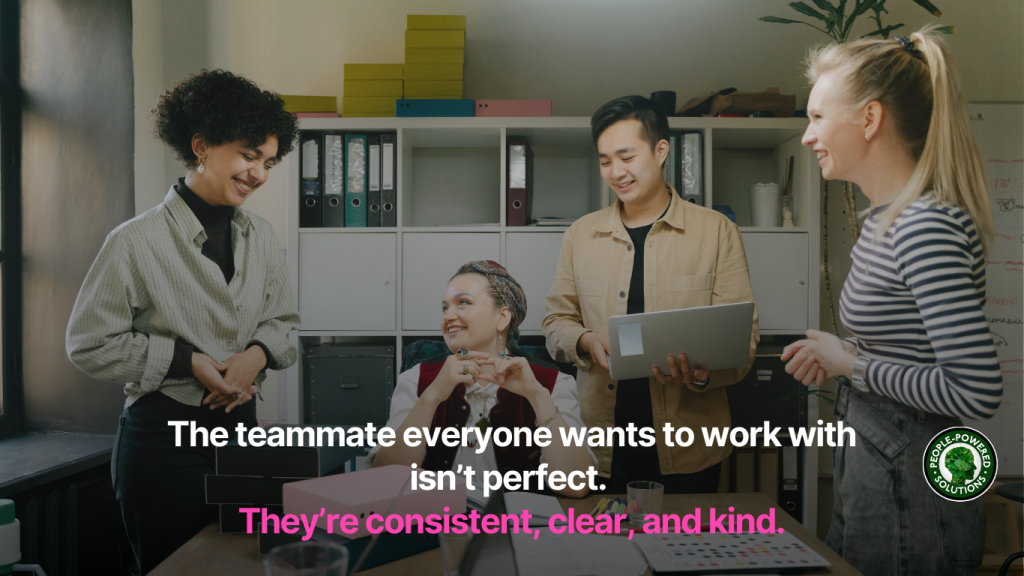
Most people think workplace culture comes from leaders or handbooks. In reality, it shows up in a much more human way. It’s shaped by how people communicate, how they follow through, and how they treat each other when the pressure is on. A strong culture only works if it’s lived, and that means every person on the team has a hand in it.
You don’t need a title to influence how your workplace feels. Every day, in a hundred small moments, you can improve team dynamics and make your corner of the workplace easier, calmer, and more respectful.
Here are five everyday habits that help you be a good teammate at work and build the kind of environment people want to stay in.
1. Keep your word, even on the small stuff
Trust is built in tiny, repeatable moments. When people know you’ll do what you said you’d do, they don’t have to carry extra worry or chase you for updates. That kind of reliability quietly helps build trust at work more than any team-building session.
Try this:
Pick one thing this week that’s yours to close the loop on. Do it when you said you would and let people know it’s done. Notice how the energy shifts when you follow through clearly and calmly.
2. Ask before you assume
Most tension doesn’t come from what is said. It comes from what people thought was meant. Assumptions create friction fast, especially in busy environments where communication is rushed. Asking clarifying questions is one of the simplest ways to strengthen team communication skills and avoid unnecessary conflict.
Try this:
Before moving ahead, pause and check: “Can I confirm I’m understanding this correctly?” or “Here’s what I think we agreed on. Does that match your understanding?”
That one moment of clarity often prevents three hours of cleanup later.
3. Appreciate out loud
One of the most overlooked workplace culture tips is the idea that recognition does not need to be formal to matter. People want to know their work has an impact. A quick moment of appreciation, especially when it’s specific, can change the tone of a whole shift.
Try this:
At the end of the week, think of one person who helped you. Tell them exactly what made a difference. Not a speech, not a performance — just honest acknowledgment.
4. Give feedback that helps, not hurts
Giving useful feedback is tougher than people admit. It isn’t about being nice or harsh. It’s about being honest in a way that supports progress. Good feedback strengthens trust because it shows you care enough to speak up and help someone succeed.
Effective feedback blends clarity and curiosity. You’re addressing what happened, why it matters, and what could support a better outcome next time.
Try this:
Start with facts. “Here’s what I noticed.”
Add impact. “This created some confusion for the next team.”
Invite collaboration. “What do you think would make this smoother next time?”
When feedback becomes a conversation instead of a correction, people grow instead of shutting down.
5. Protect people’s focus
Every team is busy. But constant interruptions, unclear handoffs, and too many “quick questions” drain energy fast. Respecting focus is one of the quietest ways to improve team dynamics because it shows you value people’s time, not just their output.
Clarity is not bureaucracy. It’s kindness.
Try this:
At the end of meetings, restate who is doing what by when.
In emails or messages, use simple subject lines like “Need by Thursday,” “Non-urgent,” or “FYI.”
Small clarity cues help everyone think more clearly and work more confidently.
When you’re the only one trying
Sometimes you make an effort to improve things, and it isn’t returned. Someone keeps dodging tasks, creating tension, or ignoring agreements. You’re trying to model healthy behavior, but it feels like swimming upstream.
When that happens, remember: it’s not your job to fix people. Your role is to show what better looks like and set boundaries where needed.
Start by naming the impact, not the blame:
“When deadlines shift without warning, it’s hard for me to plan my part. Can we create a process that works for both of us?”
If it keeps repeating, bring it forward early:
“I’ve addressed this directly, but we’re still stuck. I’d appreciate support figuring out our next step.”
And if you’ve genuinely tried and the situation still drains you, it’s okay to think about leaving. Sometimes the healthiest choice is stepping into a workplace where trust, communication, and respect are actually practiced.
You don’t have to figure it out alone
If you’re stuck in a difficult team dynamic and unsure what to do next, we can help you unpack what’s going on and decide on your next move with clarity.
Final thought
You don’t need a leadership position to influence your workplace. The way you follow through, ask questions, give credit, and communicate clearly shapes the experience of everyone around you. These are small, daily habits that quietly strengthen culture and build trust at work in a meaningful way.
That’s what makes you the kind of teammate others genuinely want to work with.

